3 September 2026
What is a plotter? How does it work, and how is it different from a regular printer?
What Is a Plotter?
A plotter is a digitally controlled device that performs specific operations based on a design prepared on a computer. Depending on the type of device, it can print, cut, mill, engrave, or mark various materials.
The most common solution is a printing plotter, also known as a wide-format printer. These devices make it possible to print graphics on paper, self-adhesive films, banner materials, textiles, wallpapers, and other substrates used in advertising and production.
However, it is important to remember that the term "plotter" covers many different types of devices. These include:
- printing plotters,
- cutting plotters,
- print-and-cut plotters,
- UV plotters,
- solvent and eco-solvent plotters,
- resin plotters,
- flatbed plotters,
- cutting tables,
- engraving machines.
Each type is designed for different applications and materials.
What Is a Plotter Used For?
Plotters are used wherever a standard printer cannot provide the required size, quality, productivity, or ability to work with specialized materials.
The main applications of plotters include:
- printing posters and advertising materials,
- producing banners and large-format mesh graphics,
- printing graphics on self-adhesive films,
- producing stickers and labels,
- creating wall decorations and wallpapers,
- printing exhibition materials,
- producing roll-ups and advertising systems,
- printing architectural drawings,
- producing indoor and outdoor signage,
- cutting advertising films,
- personalizing products and promotional materials.
Plotters are used by printing companies, advertising agencies, signage manufacturers, architects, interior designers, and companies involved in producing marketing materials.
How Does a Plotter Work?
The operating principle of a plotter depends on its type, but the basic process involves digital control of the device based on a previously prepared design.
The process usually consists of several stages.
1. Preparing the Design
The first step is to create a graphic or technical design. The file can be prepared using professional graphic design software, CAD (Computer-Aided Design), or software specifically designed for operating the device.
The design should be properly adapted to:
- the print dimensions,
- the type of material,
- the resolution,
- the printing technology,
- the required color scheme.
2. Sending the File to the Device
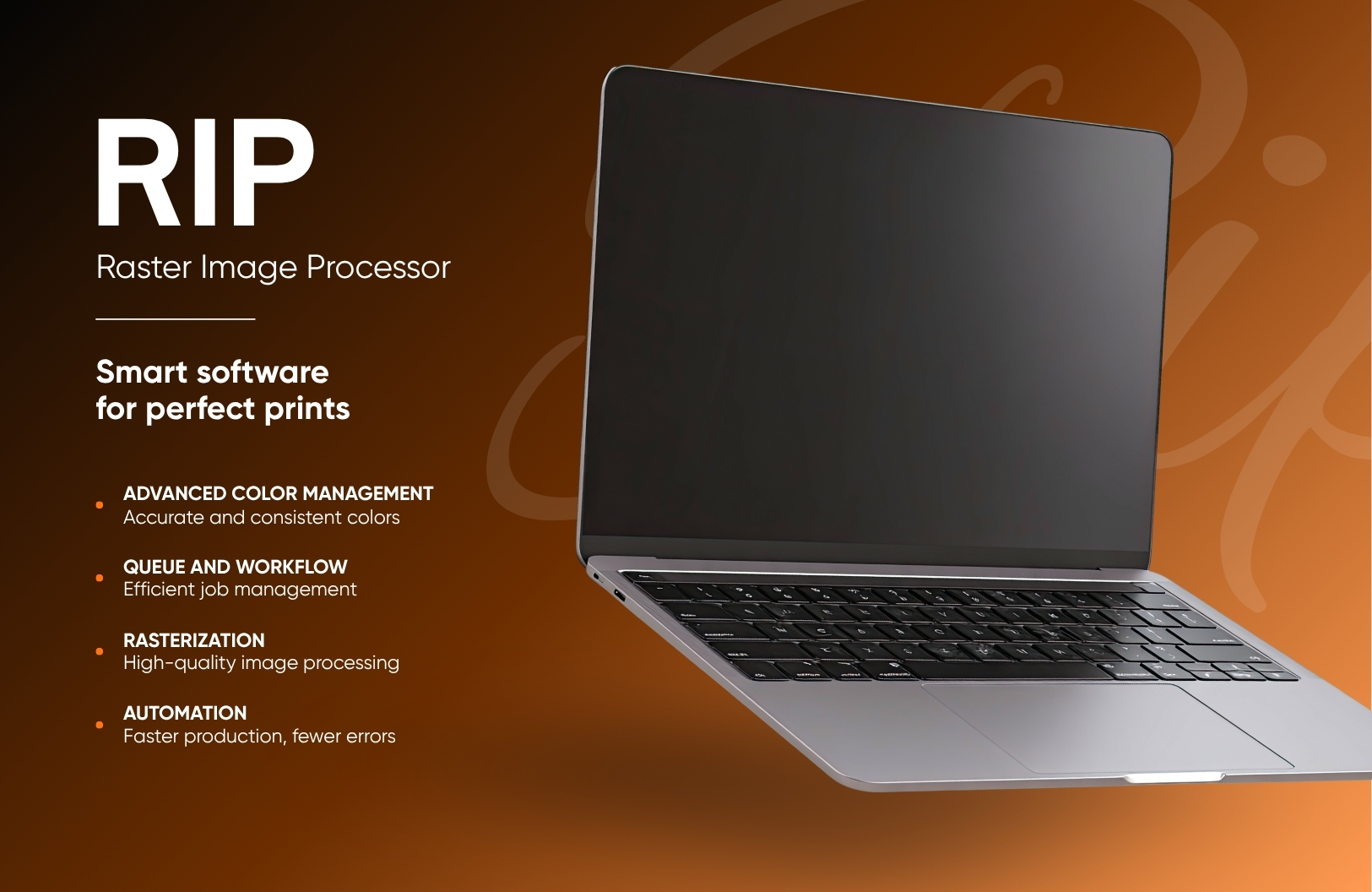
The finished design is sent from the computer to the plotter. Professional systems often use additional RIP (Raster Image Processor) software, which is responsible for interpreting the file, managing colors, and preparing data for printing.
3. Preparing the Material
Depending on the type of device, the material can be:
- loaded from a roll,
- placed on a flatbed,
- secured using a dedicated feeding system.
Plotters can work with a much wider range of substrates than standard office printers.
4. Printing or Cutting
During operation, the device precisely moves the print head, knife, or other working tool according to the programmed path.
A printing plotter applies ink to the surface of the material, while a cutting plotter uses a specialized blade to cut predefined shapes.
Thanks to their high precision, plotters can reproduce even highly detailed designs.
Types of Plotters
There are many types of plotters available on the market. The choice of a particular device should primarily depend on its intended application.
Printing Plotter
A printing plotter is used to produce large-format prints. It is mainly used in the advertising, printing, and interior decoration industries.
It can print:
- posters,
- banners,
- advertising graphics,
- photographs,
- wallpapers,
- self-adhesive films.
Cutting Plotter
A cutting plotter does not print graphics. Instead, it cuts predefined shapes into a material. It is most commonly used for working with self-adhesive films.
These devices are used to produce:
- lettering,
- stickers,
- vehicle graphics,
- signage,
- stencils.
Print-and-Cut Plotter
This solution combines printing and cutting capabilities. First, the device prints the graphic onto the material, and then it precisely cuts its shape.
These devices are particularly popular for producing stickers, labels, and advertising materials.
UV Plotter
UV plotters use ink that is cured using ultraviolet radiation. This technology makes it possible to print on a wide variety of surfaces, including rigid materials.
UV printing can be used on:
- PVC boards,
- acrylic,
- glass,
- wood,
- aluminum,
- cardboard,
- other rigid materials.
Solvent and Eco-Solvent Plotters
These devices are frequently used to produce outdoor advertising. They can print on materials such as films, banners, and mesh.
Prints can be used for:
- outdoor advertising,
- vehicle wrapping,
- banner production,
- window graphics.
What Does a Plotter Look Like?
The appearance of a plotter primarily depends on its intended use.
A roll-fed plotter usually has a construction that allows material to be fed from a roll. Its characteristic components include a feeding system, print head, and material take-up mechanism.
Flatbed plotters have a completely different design. The material is placed on a large working table, above which the print head moves.
A cutting plotter can be more compact, but it also has a precision tool-guidance system and a mechanism for moving the material.
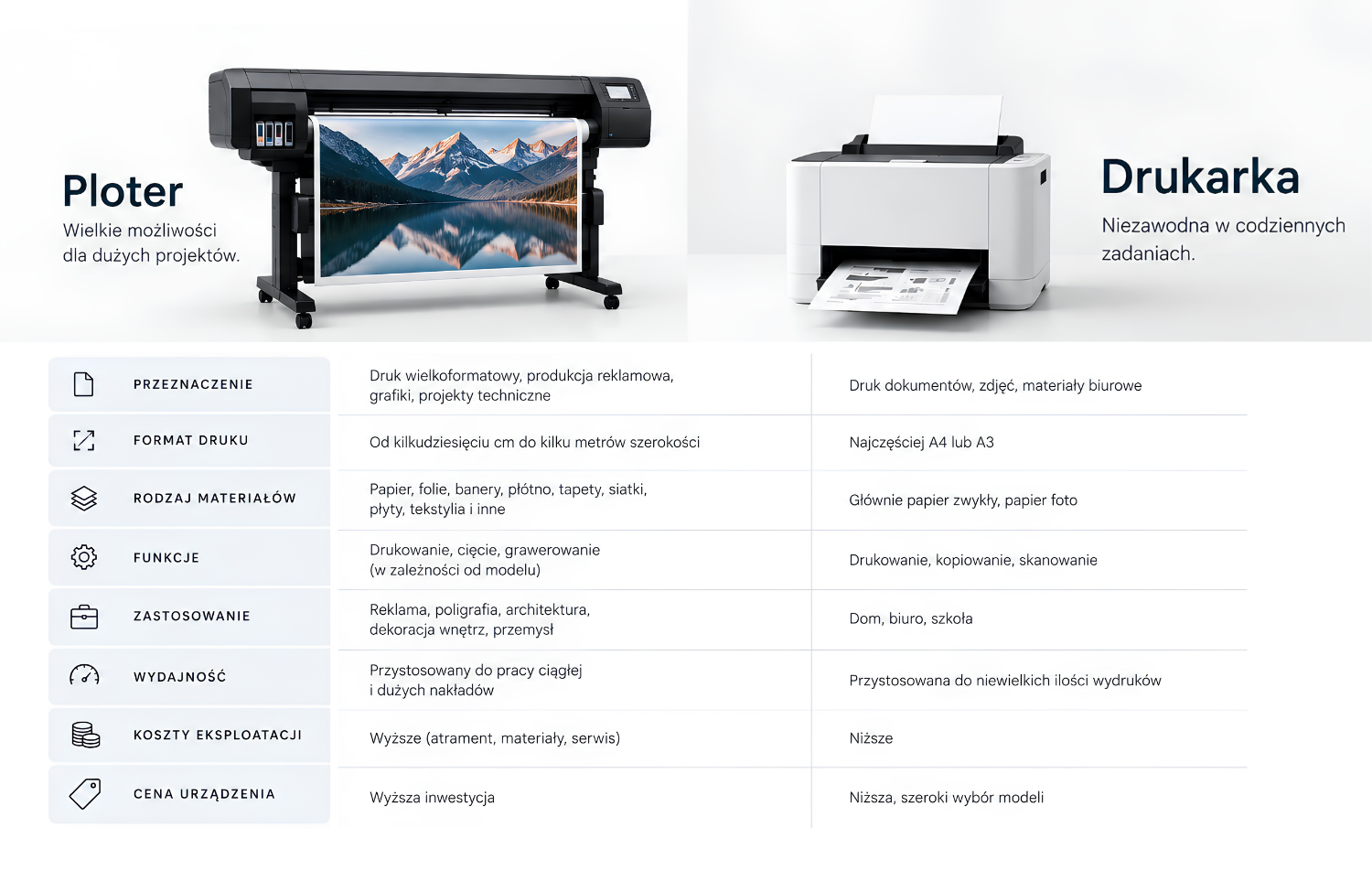
Plotter vs. Printer – Key Differences
Although both plotters and printers are used to transfer images onto a substrate, their capabilities are significantly different.
| Feature | Plotter | Regular Printer |
|---|---|---|
| Purpose | Professional and large-format production | Everyday document printing |
| Format | Large formats and roll-fed printing | Usually A4 and A3 |
| Materials | Paper, films, banners, boards, textiles | Mainly paper |
| Functions | Printing, cutting, engraving | Primarily printing |
| Applications | Advertising, printing, architecture | Home and office |
| Construction | Larger and more advanced | Compact |
| Productivity | Designed for production work | Designed for everyday printing |
The biggest difference is the scale of capabilities. A standard printer is primarily designed for printing documents, while a plotter can be part of a professional production workflow.
What Materials Can a Plotter Work With?
One of the biggest advantages of plotters is their ability to work with a wide variety of substrates.
Depending on the technology, a device may support:
- paper,
- photo paper,
- self-adhesive films,
- decorative films,
- banners,
- advertising mesh,
- textiles,
- wallpapers,
- cardboard,
- PVC boards,
- acrylic boards,
- aluminum,
- glass,
- wood.
Before choosing a device, always check which materials are compatible with the specific model and printing technology.
When Is It Worth Buying a Plotter?
Buying a plotter can be a practical solution for companies that regularly produce large-format prints or advertising materials.
A purchase may be worth considering if you:
- regularly print large formats,
- produce advertising materials,
- require high-quality graphics,
- work with different types of substrates,
- want to expand your company's services,
- outsource a large volume of printing,
- need to combine printing with cutting.
For a company working in advertising or printing, having its own plotter can increase production independence and reduce order fulfillment times.
How to Choose the Right Plotter?
Before purchasing a plotter, it is important to clearly define the company's needs. There is no single universal plotter that is ideal for every application.
Several key parameters should be considered when choosing a device.
Print Width
The width of the device should correspond to the formats that will be produced most frequently.
Printing Technology
The type of ink and printing technology affects:
- print quality,
- graphic durability,
- the types of materials that can be used,
- whether prints are suitable for indoor or outdoor applications.
Operating Speed
Speed is particularly important for companies processing a large number of orders.
Quality and Resolution
The higher the required graphic quality, the more attention should be paid to the capabilities of the device.
Operating Costs
The purchase price of a plotter is only part of the total cost. You should also consider:
- ink consumption,
- material costs,
- servicing,
- consumable parts,
- electricity,
- software.
Advantages of Using a Plotter
Professional plotters offer many benefits, particularly for companies operating in advertising and printing.
The main advantages include:
- the ability to print in large formats,
- high-quality graphic reproduction,
- precise cutting,
- the ability to work with different materials,
- high productivity,
- production automation,
- the ability to expand the range of services,
- greater control over the production process.
Can a Plotter Replace a Regular Printer?
In most cases, no.
A plotter and a printer are devices designed for different tasks. A regular printer is a better solution for everyday document printing, invoices, reports, and office materials.
A plotter, on the other hand, is better suited to situations where large formats, specialized materials, or more advanced projects are required.
In many companies, the two types of devices complement each other.
FAQ – Frequently Asked Questions
What Is a Plotter?
A plotter is a professional digitally controlled device used for printing, cutting, engraving, or processing materials. It is most commonly used for large-format printing and advertising production.
Is a Plotter a Printer?
Not exactly. A plotter can function as a large-format printer, but many devices can also perform other tasks such as cutting, engraving, or material processing.
What Is a Plotter Used For?
Plotters are used to produce posters, banners, stickers, advertising films, wallpapers, exhibition graphics, and technical documentation, among other things.
Can You Print Photos on a Plotter?
Yes. Professional plotters can produce high-quality photographs and graphics in large formats.
Is a Plotter Difficult to Operate?
Basic operation can be relatively simple, but professional use requires knowledge of materials, printing technologies, file preparation, and appropriate software.
How Much Does a Plotter Cost?
The price depends on the type of device, technology, print width, and technical specifications. In addition to the purchase price, operating and maintenance costs should also be considered.
Which Plotter Should You Choose?
The right choice depends on the intended application. Before purchasing, it is worth defining the types of materials you plan to produce, the required format, the printing technology, and the expected workload.